
10
Jun
Still waiting on referrals? Your Competitor Launched a Website This Week.
Referrals are great. They are also unpredictable, slow, and not exactly a business growth system. If your entire marketing plan is “hopefully someone mentions my name this month,” bold strategy. Meanwhile, your competitor just launched a website that explains their services, shows their work, answers customer questions, and gives people a clear way to request a quote.
That is the problem this article is here to fix. A ready-to-go website for contractors gives your business a professional online presence without waiting months for a custom build. It is not a random template with your logo slapped on it and a prayer attached. It is a structured, lead-focused website built to help service businesses look credible, get found, and turn more visitors into real inquiries.
If you already have steady referrals, good. Keep them. But your website should support those referrals, capture the people who search online, and make sure potential customers do not choose another contractor just because their website looked more serious.
Why referrals alone are not enough anymore
Most contractors do not lose jobs because they are bad at the work. They lose jobs because the customer never gets far enough to see the work. Before someone calls, they usually check your website, your photos, your service pages, your reviews, your location details, and whether your business looks legitimate.
If they cannot find you, cannot understand what you do, or land on a website that looks like it was last updated when flip phones were exciting, they move on. Dramatic? Maybe. Accurate? Unfortunately, yes.
Here is what happens when your competitor shows up better online:
- They appear when homeowners search for services in their area.
- They explain their services clearly before the first call.
- They show photos, trust signals, and project confidence.
- They make it easy to call, request a quote, or send a message.
- They look like the safer choice before anyone compares pricing.
That does not mean they are better than you. It means their website is doing a better job introducing them. Annoying? Yes. Fixable? Absolutely.
What is a ready-to-go website?
A ready-to-go website is a professionally prepared website structure built for a specific type of business. Instead of starting from a blank screen, DelosWeb begins with a proven layout, industry-aware sections, clear service flow, conversion-focused calls to action, and SEO-friendly page structure.
The goal is speed without looking cheap. Because yes, launching fast is good. Launching fast with a website that screams “I downloaded this during lunch” is less good.
A ready-to-go website should include:
- A clear homepage message that explains what you do and who you help.
- Service sections that are easy for customers and search engines to understand.
- Strong call-to-action buttons for quotes, calls, forms, and contact requests.
- Mobile-friendly design because most customers are not carefully browsing your site on a cinema screen.
- Trust-building elements such as reviews, project photos, badges, and service area details.
- SEO-ready headings, metadata direction, internal links, and image alt text.
Why speed matters when you are losing online leads
A full custom website can be the right move for growing companies with complex services, a stronger brand, or a larger content strategy. But if your business has no real website, an outdated website, or a weak online presence, waiting months to fix the problem can cost you visibility and leads.
This is where a ready-to-go website makes sense. It helps you launch faster with a professional structure already built around lead generation. You still get a website that looks polished, communicates clearly, and supports your business goals. You just do not need to spend the next quarter “thinking about the website” while competitors collect the quote requests.
Ready-to-go is a smart fit when:
- You need a professional website live quickly.
- You are relying too much on referrals and word-of-mouth.
- Your current site looks outdated, thin, or unclear.
- You want a lead-focused structure without starting from zero.
- You need service pages, contact flow, and trust signals organized properly.
The real problem is not “no website.” It is no lead system.
A website should not just sit there looking pretty. That is called decoration. Your website should help people understand your services, trust your business, and take the next step. For contractors and service businesses, that usually means calling, requesting a quote, checking project examples, or asking a question.
A ready-to-go website from DelosWeb is built around that path. The visitor should not have to solve a puzzle to figure out what you do. They should land on the page, understand your offer, see why you are credible, and know exactly how to contact you.
A lead-focused website answers the questions customers already have:
- What services do you provide?
- Do you serve my area?
- Can I trust your business?
- Do you have examples of your work?
- How do I request a quote?
- What happens after I contact you?
What your website needs if you want more calls
A contractor website does not need to be complicated. It needs to be clear, fast, trustworthy, and built around the customer’s next step. Most weak websites fail because they bury the important information, use generic headlines, hide the contact button, or say things like “quality service” without explaining anything useful.
1. A clear above-the-fold message
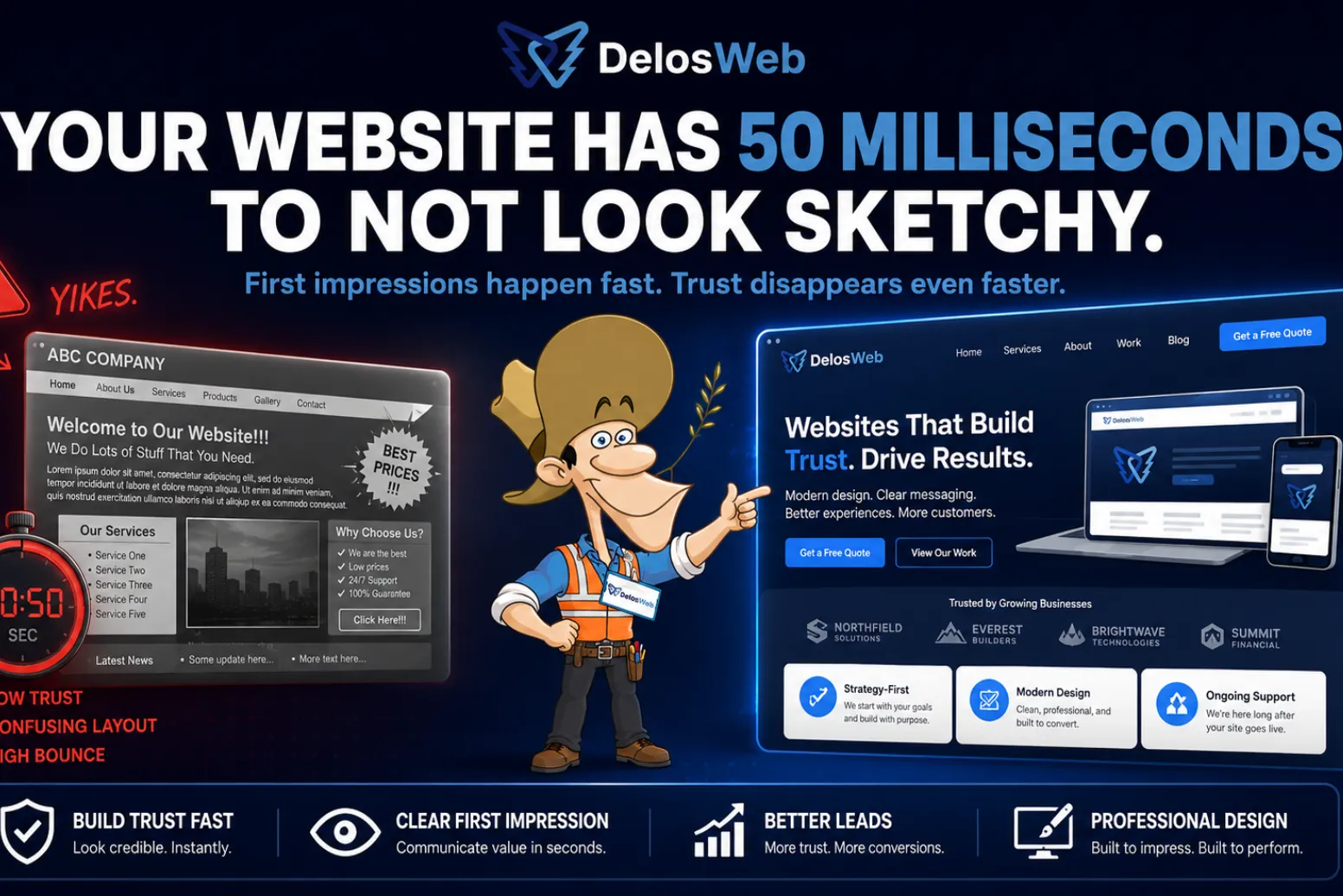
The top of your website should immediately tell visitors what you do, where you work, and why they should contact you. “Welcome to our website” is not a strategy. It is a missed opportunity wearing formal shoes.
2. Service sections with real structure
Your services should not be hidden in one tiny paragraph. If you offer remodeling, roofing, cleaning, landscaping, construction, repair, or any other local service, each major service needs a clear explanation, a strong heading, and a natural path to request a quote.
3. Trust signals that remove doubt
Customers want to know they are not about to hire a mystery person with a logo. Add reviews, project images, licensing information when relevant, years of experience, service areas, guarantees, badges, and clear contact details. Trust is not assumed online. It is built section by section.
4. Calls to action that do not whisper
Your website should make it obvious how to contact you. Call buttons, quote buttons, contact forms, and visible phone numbers should appear in the right places. A single “Submit” button at the bottom of a page is not a conversion strategy. It is hide-and-seek.
5. Mobile-first design
Many customers search from their phones. If your site is hard to read, slow to load, or annoying to navigate on mobile, people leave. Your ready-to-go website should be structured for small screens first, because that is where many quote requests begin.
Ready-to-go website vs. DIY website builder
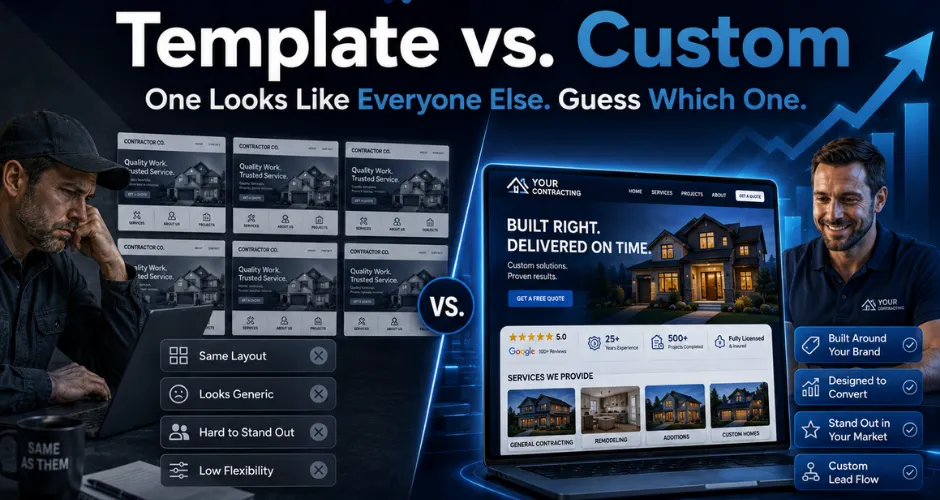
DIY builders can look cheap at first. Then you spend hours fighting spacing, fixing mobile issues, guessing what to write, wondering why nothing ranks, and asking yourself why the “easy” website now feels like a second job. Very relaxing.
A ready-to-go website gives you a more professional middle ground. You get a faster launch than a full custom build, but with better structure, clearer messaging, conversion sections, and SEO direction than a basic DIY drag-and-drop site.
| Option | Best For | Main Risk |
|---|---|---|
| DIY Website Builder | Very small budgets and basic online presence | Generic design, weak SEO structure, poor conversion flow |
| Ready-to-Go Website | Businesses that need a professional site launched faster | Less fully custom than a ground-up website |
| Custom Website | Growing brands that need deeper strategy, unique design, and advanced content | Longer timeline and higher investment |
When a ready-to-go website is the right choice
Ready-to-go is not for everyone. If your company needs custom integrations, advanced brand strategy, complex animations, a large content system, or a highly unique visual direction, a custom website may be a better fit.
But if you need a website that looks credible, explains your services, works on mobile, supports SEO, and helps people contact you sooner, ready-to-go is exactly the kind of practical move that makes sense.
It is especially useful for:
- Contractors who need to stop depending only on referrals.
- Home service businesses that need a stronger first impression.
- Local companies launching a new service or new location.
- Businesses with outdated websites that no longer build trust.
- Owners who want professional structure without a long custom timeline.
What DelosWeb builds into a ready-to-go website
DelosWeb ready-to-go websites are built to look polished and communicate clearly from day one. The point is not to create a pretty page and hope for applause. The point is to build a website that supports real business goals: visibility, credibility, and inquiries.
Core elements we focus on:
- Clear positioning: visitors quickly understand what your business does.
- Service-focused layout: your main services are easy to find and understand.
- Conversion flow: quote buttons, contact sections, and calls-to-action are placed with purpose.
- SEO-ready structure: headings, page hierarchy, internal links, and image alt direction support search visibility.
- Mobile usability: the design works smoothly on phones, tablets, and desktops.
- Trust sections: reviews, project photos, badges, process steps, and FAQs help reduce hesitation.
Internal links your website should use
One page alone rarely does all the work. A strong website connects related pages so visitors and search engines can understand your services clearly. That means your blog should not just exist in a lonely corner collecting dust. It should support the main service pages.
For this topic, the most important internal links are:
- Ready-To-Go Websites for businesses that need to launch faster.
- Custom Websites for companies that need a fully unique build.
- Website Design for stronger branding, trust, and lead-focused layouts.
- Contact DelosWeb to talk about the right website path.
Final answer: stop waiting, start showing up
Referrals can still be valuable. Nobody is saying to throw them away. But if referrals are your only source of new business, your growth depends on other people remembering to mention you. That is not a marketing plan. That is a campfire story with invoices.
A ready-to-go website helps your business take control of the first impression. It gives customers a place to find you, trust you, understand your services, and contact you when they are ready to start. Your competitor does not need to be better than you to win the lead. Sometimes they just need to be easier to find.
So yes, keep your referrals. But build the website too. Waiting around is charming in romantic comedies. In business, it is just expensive.
Ready to stop hoping the phone rings?
Launch a ready-to-go website built to make your business look credible, get found online, and turn more visitors into quote requests.
Explore Ready-To-Go Websites// frequently asked questions
Questions business owners ask before they stop relying only on referrals.
No confusing tech talk. No “just trust the process” fog machine. Clear answers about ready-to-go websites, lead generation, SEO structure, and why your business needs more than word-of-mouth if it wants predictable growth.
Start My WebsiteA ready-to-go website is a professionally structured website built from a proven, industry-aware layout. It helps your business launch faster with clear messaging, service sections, calls to action, mobile-friendly design, and SEO-ready structure.
No. A cheap template usually gives you a layout and leaves you to figure out the strategy. A DelosWeb ready-to-go website is built around business goals: clear services, trust signals, conversion flow, SEO structure, and a professional first impression.
Yes. Referrals often check your website before they call. A strong website supports word-of-mouth by making your business look credible, showing your services, answering common questions, and making it easy to request a quote.
It gives visitors a clear path from interest to action. The structure includes strong headings, service explanations, trust sections, quote buttons, contact forms, phone links, and mobile-friendly design so potential customers can contact you without confusion.
It depends on the business. Ready-to-go is best when you need to launch faster with a professional structure. Custom website design is better when you need a unique brand experience, deeper strategy, advanced content, or a more complex website build.
Yes. A ready-to-go website can be built with SEO-friendly headings, service-focused content, internal links, image alt text, metadata direction, mobile performance, and FAQs that answer real search questions from potential customers.
Ready-to-go websites are a strong fit for contractors, home service businesses, local companies, startups, and business owners who need a polished online presence faster without starting from a blank page or wasting time on a DIY builder.
Yes. DelosWeb can help you choose based on your timeline, budget, services, brand goals, competition, and how much customization your business actually needs. Shocking idea: the right answer is not always the most expensive one.