10
Jun
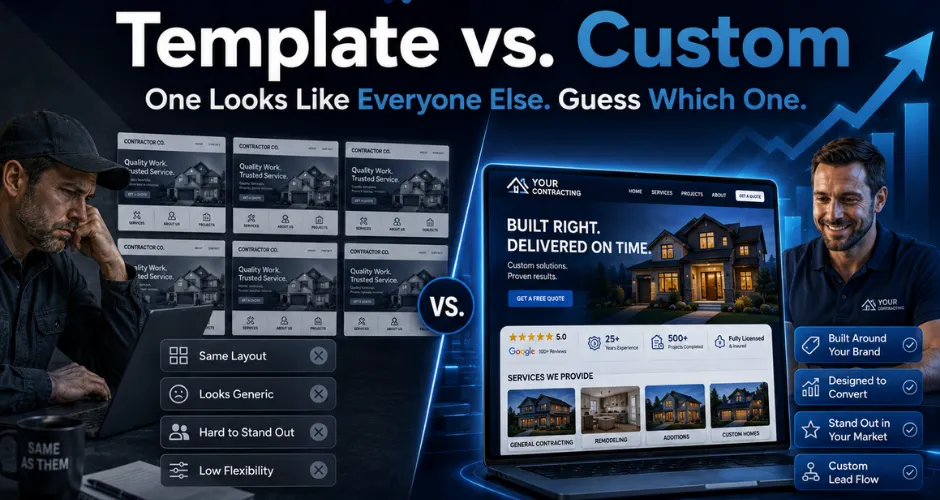
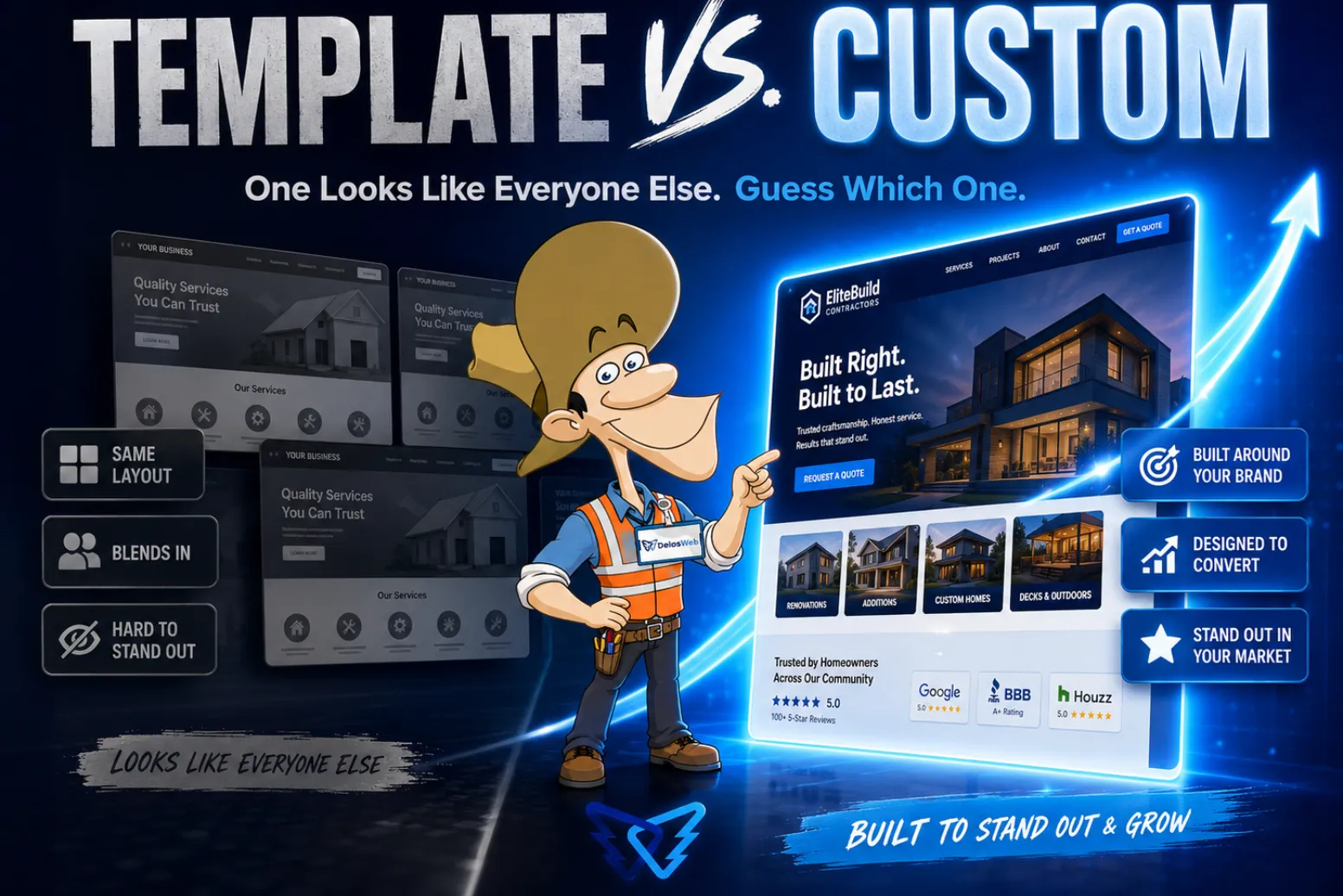
Template vs. Custom: One Looks Like Everyone Else. Guess Which One.
A website template can get your business online. That is the good news. The bad news? It can also make your company look exactly like every other contractor, service provider, or “trusted local expert” using the same layout, same blocks, same icons, and the same heroic sentence about “quality service.” Very brave. Very original.
The real question is not whether templates are bad and custom websites are always better. That would be too easy, and we would hate to remove all nuance from the internet. The better question is this: does your website need to simply exist, or does it need to help your business stand out, build trust, and generate better leads?
For contractors and service businesses, the difference matters. A generic template can make your business look like it borrowed someone else’s suit. A custom website for contractors can be built around your services, your brand, your service area, your sales process, and the way real customers decide who to contact.
What is a website template?
A website template is a pre-designed layout that can be reused across different businesses. Templates usually include ready-made sections such as a hero area, service cards, about section, testimonial area, image gallery, contact form, and footer. They can be useful when a business needs to launch quickly or has a smaller budget.
The problem starts when the template becomes the strategy. If your website is just a layout with your logo, a few swapped images, and copy that could apply to any business in any city, then your site may be online, but it is not doing much heavy lifting.
A template website usually works best when:
- You need a simple online presence quickly.
- Your business is new and still testing its offer.
- Your budget is limited and you need a practical starting point.
- You do not need a unique brand experience yet.
- You only need basic pages such as Home, Services, About, and Contact.
Templates are not automatically terrible. A bad template is terrible. A template used with no strategy is terrible. A template pretending to be a complete marketing system is especially talented at being terrible.
What is a custom website?
A custom website is designed and structured around your specific business goals. Instead of forcing your company into a pre-made layout, the website is planned around your brand, services, audience, location strategy, project types, calls to action, content hierarchy, and conversion flow.
For contractors, remodelers, roofers, HVAC companies, landscapers, cleaning companies, and other service businesses, a custom website can explain what makes your company different before a customer ever picks up the phone. That matters because online visitors compare quickly. They do not lovingly study your website like it is a museum exhibit. They scan, judge, and move.
A custom contractor website can include:
- Custom homepage messaging built around your strongest selling points.
- Service pages designed for your exact trade, offers, and service areas.
- Project sections that show your work with purpose, not just random photos.
- Trust signals such as reviews, licenses, experience, badges, FAQs, and guarantees.
- Conversion-focused calls to action placed where visitors actually need them.
- SEO-ready structure for service keywords, local intent, and long-tail searches.
- Brand visuals that help your business feel memorable instead of interchangeable.
The real difference: layout vs. strategy
The biggest difference between a template and a custom website is not just design. It is strategy. A template gives you a structure. A custom website asks what the structure needs to accomplish. Shocking concept: the website should be built around the business, not the other way around.
A contractor website needs to answer real customer questions quickly. What do you do? Where do you work? Can I trust you? Do you handle my type of project? How do I request a quote? Why should I call you instead of the other company whose website also says “quality work” seventeen times?
Templates often focus on:
- Filling pre-made sections.
- Using generic headlines that sound safe but say little.
- Making the site look acceptable enough to publish.
- Matching a demo design that was not built for your actual business.
Custom websites focus on:
- Positioning your business clearly.
- Building pages around your services and customer intent.
- Creating a conversion path from visitor to quote request.
- Making your brand easier to remember and easier to trust.
Why template websites often look the same
Many contractor templates follow the same pattern: big hero image, vague headline, three service cards, a short about section, a testimonial slider, and a contact form. There is nothing wrong with those sections. The problem is when they are used with no original positioning, no real content strategy, and no reason for the customer to remember you.
If five competitors can use the same layout and still make sense, the website is probably not saying enough about your business. It may look clean, but clean alone does not equal persuasive. A white wall is also clean. Nobody hires it.
Common signs your template is holding you back:
- Your homepage headline could apply to any contractor in any city.
- Your services are listed but not explained.
- Your photos do not support a clear sales message.
- Your calls to action are weak, hidden, or repeated without strategy.
- Your site has no strong local or service-specific SEO structure.
- Your competitors’ websites feel oddly familiar because they basically are.
When a template website is enough
A template can be enough when your main goal is to get online quickly with a clean basic presence. If you are starting out, validating a service, or simply need something better than no website, a well-structured template or ready-to-go website can be a smart move.
At DelosWeb, this is why we separate Ready-To-Go Websites from full custom builds. Some businesses need speed first. They need a professional, SEO-aware, lead-focused website without waiting months. That is a real need, not a crime against design.
A template or ready-to-go website can be the right call if:
- You need to launch fast.
- You do not have a large content strategy yet.
- You need a professional starting point before going fully custom.
- Your services are simple and easy to organize.
- Your main goal is credibility and basic lead capture.
When a custom website is worth it
A custom website becomes worth it when your business needs more than a clean layout. If you are in a competitive market, offer higher-ticket services, serve multiple customer types, have a strong portfolio, or need to look more premium than the “we do it all” crowd, custom design can create a serious advantage.
For contractors, a custom website is especially valuable when the site needs to support real business growth: stronger lead quality, better service clarity, local SEO structure, project storytelling, trust-building, and a sales process that does not rely on customers guessing what to do next.
Custom is usually the better choice when:
- Your competitors are already investing in professional websites.
- Your business has multiple services, locations, or customer segments.
- You need stronger branding and a more premium first impression.
- You want service pages designed around search intent and lead generation.
- Your current website looks acceptable but does not produce enough inquiries.
- You want a site that feels like your company, not a rented outfit.
Template vs. custom website comparison
The right choice depends on your goals, timeline, budget, and how much differentiation your business needs. Here is the honest comparison, without the dramatic agency fog machine.
| Website Type | Best For | Strength | Main Limitation |
|---|---|---|---|
| Basic Template | Small businesses that need a simple online presence | Fast and affordable starting point | Can look generic and limit SEO/conversion strategy |
| Ready-To-Go Website | Businesses that need to launch quickly with professional structure | Faster launch with better service flow and lead-focused sections | Not as unique or flexible as a fully custom build |
| Custom Website | Growing businesses that need differentiation, strategy, and stronger conversion flow | Built around your brand, services, audience, and goals | Requires more planning, time, and investment |
SEO difference: why structure matters
Search engines do not rank your website because it looks pretty in the demo preview. They need structure, relevance, content, internal links, technical clarity, and pages that match what people are searching for. A template can support SEO if it is handled correctly, but many template sites fail because the content is thin, the headings are generic, and the service pages are barely more than placeholders.
A custom website allows the SEO structure to be planned around your real services and goals. That can include service-specific pages, local search intent, FAQ sections, internal linking, optimized image alt text, conversion-focused headings, and stronger content architecture.
For contractors, SEO-friendly structure should include:
- A clear homepage that introduces your primary service category.
- Individual service pages for major offers instead of one crowded services page.
- Location-aware content where relevant and natural.
- FAQ sections that answer real customer questions.
- Project or portfolio pages that support trust and topical relevance.
- Internal links connecting blogs, services, portfolio, and contact pages.
Conversion difference: pretty is not the same as persuasive
A pretty website can still fail. It can have nice spacing, smooth animations, and gorgeous images while doing absolutely nothing to make a visitor contact you. Very artistic. Also very quiet.
A custom website gives you more control over the conversion path. That means your calls to action, service sections, trust signals, reviews, project examples, contact forms, and page flow can be placed intentionally. The visitor should not have to hunt for the next step. If your website makes people work to contact you, congratulations, you invented friction.
A conversion-focused contractor website needs:
- Clear quote or contact buttons above the fold.
- Service explanations that remove confusion.
- Trust signals close to decision points.
- Mobile-friendly buttons and forms.
- Strong project images with helpful context.
- Simple next steps after the visitor decides to reach out.
Brand difference: do you want to be remembered or just published?
Templates often make businesses look published. Custom websites help businesses look positioned. That difference matters when customers are comparing multiple contractors and trying to decide who feels more trustworthy, more professional, and more capable.
Your brand is not just your logo. It is the way your website explains your value, presents your work, organizes your services, handles objections, and makes the customer feel like contacting you is the obvious next step.
A stronger brand-focused website can help you communicate:
- What type of projects you want more of.
- Why your process is easier or more reliable.
- What makes your work different from cheaper competitors.
- Why homeowners or business owners should trust you.
- What kind of result customers can expect after contacting you.
Which one should your business choose?
Choose a template or ready-to-go website if your business needs speed, structure, and a better online presence now. Choose a custom website if your business needs a stronger brand position, deeper service strategy, better differentiation, and a website that can support long-term growth.
The wrong choice is not choosing a template. The wrong choice is pretending a generic template will magically create a competitive advantage. It might get you online. It may not make you stand out. Those are different jobs.
Simple decision framework:
- Need to launch fast? Start with a Ready-To-Go Website.
- Need to stand out in a competitive market? Build a Custom Website.
- Need stronger service pages and SEO structure? Custom is usually better.
- Need a professional foundation before a bigger build? Ready-To-Go can be the smart first step.
- Need your site to look nothing like everyone else? You already know the answer.
How DelosWeb helps you choose the right website path
DelosWeb does not treat every business like it needs the same website. Some companies need a fast, professionally structured launch. Others need a fully custom build with stronger brand strategy, service architecture, content planning, and conversion-focused design.
That is why DelosWeb offers both Ready-To-Go Websites and Custom Websites. The goal is not to sell you the biggest option. The goal is to build the website that actually matches your business stage. Weirdly practical, we know.
DelosWeb focuses on:
- Clear messaging: so visitors understand your business fast.
- Service structure: so your offers are easy to find and easy to trust.
- Conversion flow: so visitors know how to request a quote or start a conversation.
- SEO-ready planning: so pages are built with search intent in mind.
- Visual credibility: so your website looks as serious as your work.
Final answer: templates can launch you. Custom can position you.
Templates are useful when speed and budget matter most. Custom websites are powerful when differentiation, trust, conversion, and growth matter more. Neither option is automatically wrong. The wrong move is building a website that does not match your goals and then wondering why it does not produce results.
If your business just needs to get online professionally, a ready-to-go website may be the right first move. If your business needs to stand out, explain its value, support SEO, and convert better leads, custom website design is where the real advantage begins.
Your website should not look like it came from the same conveyor belt as your competitors. Unless your brand strategy is “please confuse me with everyone else,” in which case, excellent commitment to the bit.
Ready to stop blending in?
Build a website that actually fits your business, your services, and the customers you want to attract. DelosWeb can help you choose between ready-to-go and custom without the agency fog machine.
Explore Custom Websites// frequently asked questions
Questions businesses ask before choosing template or custom.
No vague design talk. No pretending every company needs the same solution. Clear answers about templates, ready-to-go websites, custom builds, SEO structure, and what actually helps contractors stand out online.
Start My WebsiteA custom website is usually better when your business needs stronger branding, deeper strategy, better service pages, SEO structure, and a design that does not look like everyone else. A template can still work when you need a faster and simpler starting point.
A contractor can use a template when the goal is to launch quickly, create a basic online presence, or start with a smaller budget. The template still needs strong content, clear calls to action, mobile usability, and service structure to be effective.
A custom contractor website is worth it when your business needs to stand out in a competitive market, explain multiple services, show project credibility, improve lead quality, support local SEO, and create a stronger first impression than generic competitors.
Yes, a template website can rank if the SEO foundation is handled properly. The problem is not the template alone. The problem is thin content, generic headings, poor internal linking, weak service pages, slow performance, and no clear search intent strategy.
A custom website can be designed around the visitor journey. That means stronger service sections, clearer quote buttons, trust signals near decision points, better mobile flow, portfolio support, FAQs, and page layouts that guide people toward contacting your business.
Ready-to-go websites are built from professional structures that help businesses launch faster. Custom websites are planned and designed more deeply around your brand, services, audience, SEO goals, and conversion strategy. One is faster. The other is more tailored.
Yes. A custom website can present your company’s specific strengths, process, project types, reviews, service areas, and brand personality in a way a generic template usually cannot. Standing out is helpful when customers are comparing several businesses quickly.
Yes. DelosWeb can help you choose based on your timeline, budget, business stage, services, competition, brand goals, and how much flexibility you need. The best website is not always the most expensive one. Annoyingly reasonable, but true.