12
Jun
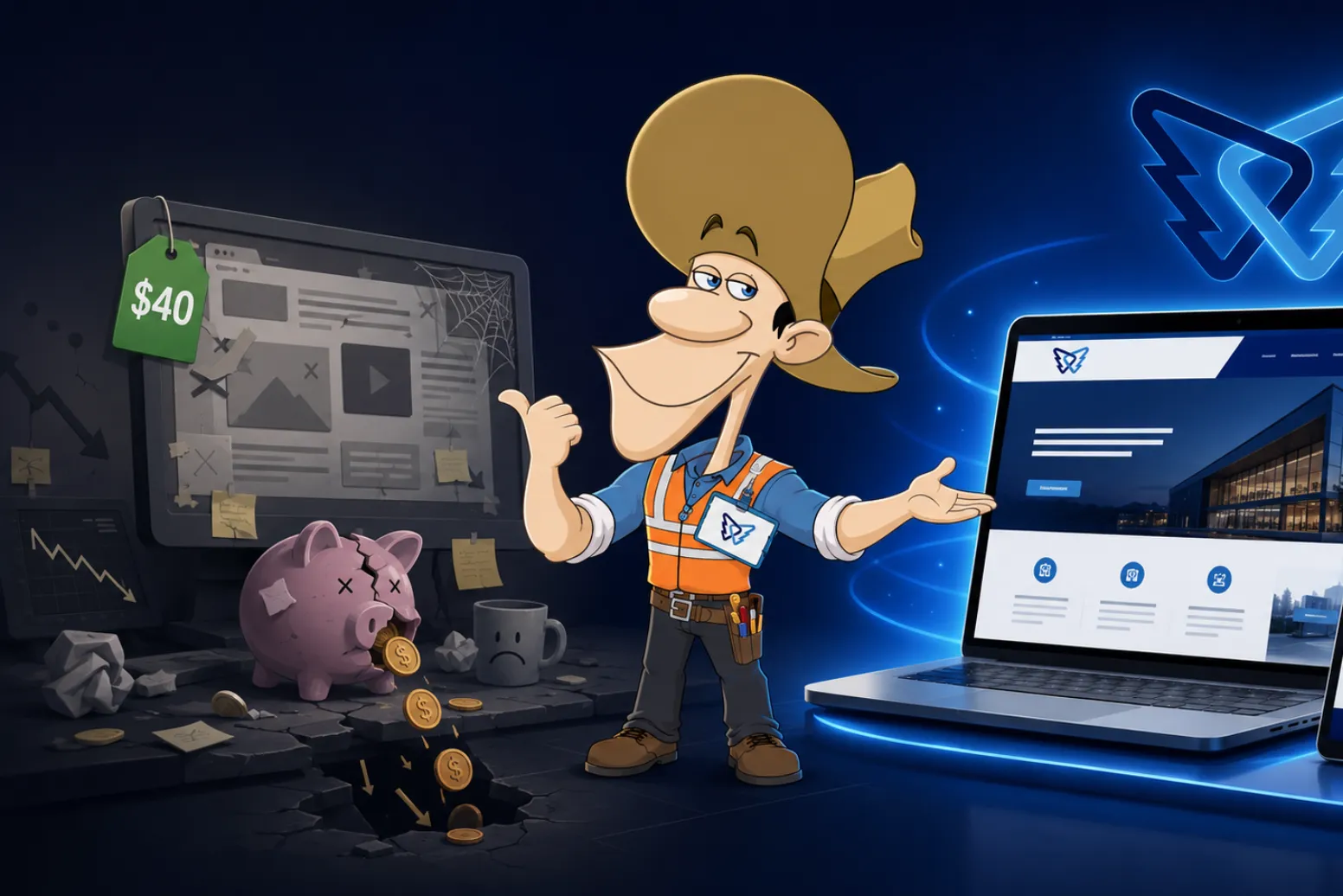
Your $40-a-Month Wix Site Is a Very Expensive Way to Save Money.
A cheap website sounds smart at first. Forty dollars a month, a few drag-and-drop sections, some stock photos, a contact form, and suddenly your business is “online.” Beautiful. Except the website looks generic, says almost nothing useful, works awkwardly on mobile, and quietly convinces potential customers to call someone else.
That is where the “cheap” website gets expensive. The subscription is not the real cost. The real cost is lost trust, weak first impressions, poor service clarity, bad conversion flow, and quote requests that never happen because your website did not make your business look credible enough.
A ready-to-go website for service businesses gives you a better option: faster than a full custom build, more strategic than a basic DIY website builder, and built with the structure your business needs to look professional, explain services clearly, and turn visitors into real inquiries.
The real cost of a cheap website is not the monthly payment
Business owners often focus on what the website costs per month. That makes sense, but it is only one part of the equation. A cheap website can still be expensive if it makes customers hesitate, misunderstand your services, or leave without contacting you.
Customers do not see your monthly savings. They see your homepage, your images, your service descriptions, your contact buttons, and whether your business looks like a safe choice. If your website looks like a rushed weekend project, the discount is not exactly helping.
A cheap DIY site can cost your business when:
- Visitors do not trust the business enough to call.
- Your services are listed but not explained clearly.
- Your website looks generic compared to competitors.
- Your contact form or call button is hard to find.
- Your mobile layout feels clunky, slow, or unfinished.
- Your pages are not structured around search intent.
DIY website builders are tools, not strategies
Website builders can be useful. They let business owners create pages without code. That part is fine. The problem is when the tool is mistaken for the strategy. A platform can give you sections, but it does not automatically give you messaging, positioning, SEO structure, trust flow, or conversion planning.
A hammer does not build a house by itself. A website builder does not build a lead-generating website by itself. Shocking, we know. Tools still need strategy.
Most DIY websites struggle because they are missing:
- A clear homepage message that explains the business quickly.
- Service pages or sections with useful explanations.
- Calls to action placed where visitors actually need them.
- Trust signals such as reviews, projects, badges, and FAQs.
- SEO-friendly headings, internal links, and page hierarchy.
- A mobile experience built for real customers, not just the desktop preview.
Why “good enough” can still lose leads
A website can look acceptable and still fail. That is the tricky part. It may not be broken. It may not look terrible. It may simply be forgettable, unclear, and easy to ignore. In a competitive market, “good enough” is often just another way to say “not convincing.”
Potential customers compare quickly. If your competitor has a website that explains services clearly, shows proof, answers questions, and makes the next step obvious, they may win the lead before price is even discussed.
What a ready-to-go website does better
A DelosWeb ready-to-go website is built for service businesses that need to launch professionally without starting from zero. It gives your company a stronger foundation: service sections, calls to action, trust-building content, mobile-friendly structure, and SEO-ready page flow.
Instead of handing you a blank page and wishing you luck, a ready-to-go website starts with a business-focused structure. The goal is simple: help visitors understand what you do, trust your company, and take the next step. Wild idea, but websites should probably do that.
A ready-to-go website should include:
- Clear positioning: visitors understand what you do quickly.
- Service-focused sections: your main offers are easy to find and understand.
- Conversion flow: quote buttons, forms, and contact areas are placed with purpose.
- Trust elements: reviews, project proof, process details, and FAQs reduce hesitation.
- SEO-ready structure: headings, internal links, alt text, and page hierarchy support visibility.
- Mobile-first design: the site works for people searching from their phones.
Cheap website vs. ready-to-go website
A cheap DIY website gives you a platform. A ready-to-go website gives you a stronger business foundation. Both can technically put your business online. Only one is built with credibility, service clarity, and lead generation in mind from the start.
| Website Option | What You Get | Main Risk | Best Use |
|---|---|---|---|
| DIY Website Builder | A platform and basic design tools | You still need strategy, content, SEO, and conversion planning | Very basic online presence |
| Cheap Template Site | A quick layout with limited customization | Generic look, weak message, low differentiation | Temporary starting point |
| Ready-To-Go Website | Professional structure, service flow, SEO-ready content, and lead-focused layout | Less custom than a fully tailored build | Businesses that need to launch faster and look credible |
When your “affordable” website becomes expensive
A website becomes expensive when it fails to support your business goals. If it does not help people trust you, understand your services, or contact you, the low price is not the win you think it is.
This is especially true for service businesses. A plumber, contractor, roofer, cleaner, landscaper, remodeling company, HVAC company, or local service provider does not need a website that simply exists. They need a website that makes customers feel comfortable enough to reach out.
Your DIY site may be costing you if:
- You rarely receive leads from your website.
- Customers still ask basic questions your site should answer.
- Your services are hard to understand online.
- Your website looks less professional than your actual work.
- Your competitors look more trustworthy before the first call.
- Your mobile version feels like it was designed by accident.
What service businesses actually need online
Most service businesses need the same core things from their website: clarity, trust, speed, proof, and an easy path to contact. The design should not make visitors think too hard. They should land on the page, understand the service, see why the business is credible, and know what to do next.
A lead-focused service business website should answer:
- What services do you offer?
- Who do you help?
- Where do you provide service?
- Why should people trust your company?
- What proof do you have?
- How can someone request a quote or consultation?
If your website does not answer those questions, customers do not wait patiently while your homepage “loads the vibe.” They leave. Very inconsiderate, but very common.
Ready-to-go does not mean generic
A common mistake is thinking “ready-to-go” means cheap, basic, or generic. That is not the point. A ready-to-go website should be prepared with a professional structure, then adapted to the business so it feels clear, trustworthy, and useful.
The difference is that you are not paying for someone to reinvent every section from scratch. You are getting a smarter starting point with the right layout, conversion flow, and content direction already planned.
DelosWeb ready-to-go websites focus on:
- Professional first impressions.
- Service clarity for customers and search engines.
- Strong calls to action for quote requests.
- Mobile-friendly layouts that do not fight the user.
- Trust-building sections such as FAQs, process, reviews, and proof.
- Internal links that guide visitors toward service and contact pages.
What DelosWeb fixes
DelosWeb helps businesses move from “I made something online” to “my website actually supports my business.” We focus on structure, messaging, service clarity, SEO readiness, mobile design, and conversion flow. Very boring things, apparently, until they start producing better inquiries.
- Ready-To-Go Websites for faster professional launches.
- Custom Websites for deeper strategy and stronger brand positioning.
- Website Design for better first impressions and lead-focused layouts.
- Contact DelosWeb to stop treating your website like a monthly receipt.
Final answer: saving money should not cost you leads
A cheap website can be a starting point, but it should not become the reason customers hesitate. Your site needs to look credible, explain your services, work on mobile, support SEO, and make contacting you simple.
Saving money is great. Looking cheap online is less inspiring. Especially when your competitor looks polished, prepared, and quote-ready.
A ready-to-go website gives your service business a faster path to a professional online presence without forcing you to fight a DIY builder, guess your content structure, or hope your homepage somehow converts. Hope is not a website strategy. Cute, but no.
Ready for a website that looks like a business asset?
DelosWeb Ready-To-Go Websites help service businesses launch faster with professional structure, clear messaging, SEO-ready content, and lead-focused design.
Explore Ready-To-Go Websites// frequently asked questions
Questions business owners ask before replacing a cheap DIY website.
No platform worship. No “just drag and drop” fantasy. Clear answers about DIY websites, ready-to-go websites, trust, SEO, and why cheap can get expensive when leads disappear.
Start My WebsiteNot always. A DIY website can be a starting point. It becomes a problem when it looks generic, lacks clear service content, performs poorly on mobile, has weak SEO structure, or fails to turn visitors into inquiries.
They often lack strong messaging, service structure, trust signals, conversion flow, SEO-ready content, and mobile optimization. The platform may be easy to use, but it does not create strategy automatically.
A ready-to-go website is often a better option for businesses that need to launch quickly but still want a professional structure, clearer content, stronger trust sections, and better lead-focused design.
Yes. A ready-to-go website can include SEO-friendly headings, service-focused content, internal links, FAQs, image alt text, mobile-friendly layout, and clear page hierarchy.
Ready-to-go websites are a strong fit for service businesses that need a professional website live faster, without spending months on a full custom build or wasting time trying to force a DIY builder into a real lead-generation system.
Consider replacing it if it looks outdated, gets few leads, has weak messaging, loads slowly, performs poorly on mobile, or makes competitors look more professional and trustworthy online.
It depends on your goals. Ready-to-go is best when you need to launch faster with a professional structure. Custom website design is better when your business needs deeper branding, advanced content, unique design, or a more tailored conversion strategy.