12
Jun
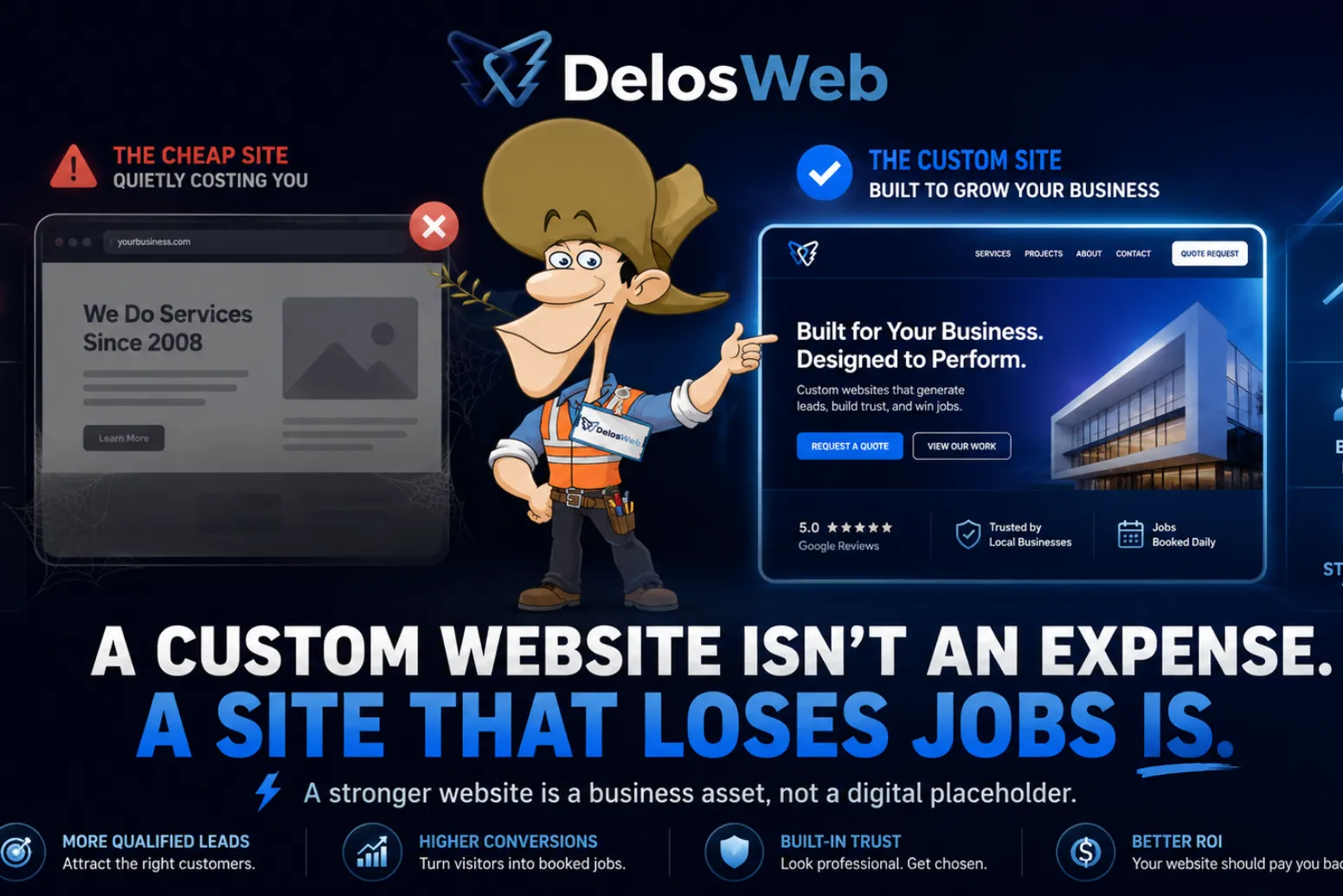
A Custom Website Isn’t an Expense. A Site That Loses Jobs Is.
A custom website sounds expensive until you compare it with the quiet cost of a website that does not work. A weak website does not send you a polite warning that says, “Hey, three potential customers left because this page looked outdated.” It just sits there, looking harmless, while better leads go somewhere else.
That is the part many contractors miss. The real expense is not always the website you invest in. Sometimes the real expense is the one that fails to explain your services, fails to build trust, fails to show your work, and fails to make customers feel confident enough to request a quote.
A custom website design for contractors is built around your business, your services, your customers, and your growth goals. It is not just a prettier homepage. It is a strategic online presence built to help your company look credible, communicate clearly, support SEO, and turn more visitors into real inquiries.
The expensive website is the one that does not convert
Contractors often ask how much a website costs. Fair question. But a better question is: how much is your current website costing you when it fails to help people choose your business?
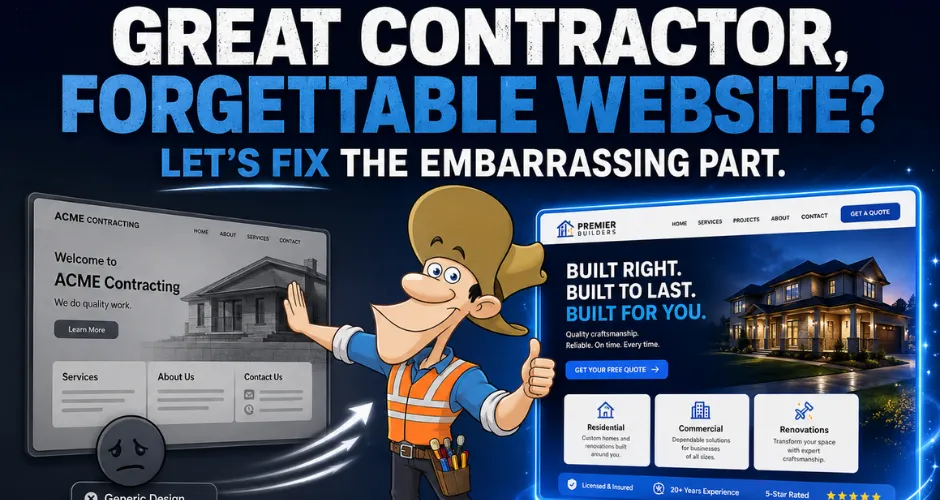
A website that looks outdated, confusing, or generic can make a strong company look weaker than it really is. That is painful because your work may be excellent, your team may be experienced, and your service may be better than the competitor’s. But if their website builds trust faster, they may get the call first.
A weak website can cost contractors when:
- Visitors leave before understanding the services.
- Customers do not trust the business enough to request a quote.
- The website looks generic compared to competitors.
- Project photos, reviews, and proof are missing or poorly presented.
- The site does not guide visitors toward a call, form, or consultation.
- Search engines cannot clearly understand the service structure.
Custom website design is not just “making it look nice”
A nice-looking website is good. A nice-looking website that does not explain anything, rank for anything, or convert anyone is less exciting. Pretty confusion is still confusion. It just has better lighting.
Custom website design should go beyond colors and layouts. It should shape how customers understand your company, how your services are organized, how trust is built, and how visitors move from interest to action.
A strong custom contractor website should include:
- Brand positioning: a clear message that separates your company from generic competitors.
- Service strategy: dedicated sections or pages that explain what you do in useful detail.
- Conversion flow: quote buttons, contact forms, calls, and next steps placed with purpose.
- Trust signals: reviews, project proof, process details, credentials, and FAQs.
- SEO-ready structure: headings, internal links, page hierarchy, metadata direction, and content planning.
- Responsive design: a polished experience across desktop, tablet, and mobile.
Why contractors need more than a generic website
Contractor websites have a specific job. They need to help potential customers feel comfortable hiring someone for work that may be expensive, personal, and important. Remodeling, roofing, construction, HVAC, electrical, plumbing, landscaping, and other service projects require trust before the first conversation.
A generic website does not do enough of that work. It may list your services, show a few images, and include a contact form. But if it does not explain your value, answer real questions, show proof, or make your business memorable, it becomes another online brochure that customers forget in eight seconds.
A contractor website needs to answer:
- What type of work do you specialize in?
- What areas or customers do you serve?
- Why should someone trust your company?
- What does your process look like?
- Can visitors see examples of your work?
- How can someone request a quote without confusion?
The hidden cost of looking like everyone else
A template can get a site online. A custom website can help a business stand apart. That difference matters when customers are comparing multiple companies and every site seems to say the same things: quality service, experienced team, affordable prices, customer satisfaction. Groundbreaking. Truly never heard before.
Custom design gives your business room to communicate what actually makes it different. Your process, your project quality, your customer experience, your service focus, your proof, and your values can be built into the structure instead of squeezed into a template that was never made for your business.
When your website looks like everyone else:
- Your business becomes harder to remember.
- Your services feel less specialized.
- Your brand looks replaceable.
- Your competitors can look more professional with better positioning.
- Customers may choose based only on price because your value is not clear.
Custom website vs. ready-to-go website
Ready-to-go websites and custom websites both have a place. The right choice depends on your timeline, budget, competition, brand goals, and how much strategy your business needs.
| Website Option | Best For | Main Advantage | Main Limitation |
|---|---|---|---|
| DIY Website | Very basic online presence | Low monthly cost | Weak strategy, generic design, poor conversion flow |
| Ready-To-Go Website | Businesses that need a professional launch faster | Strong structure, faster timeline, SEO-ready foundation | Less tailored than a fully custom build |
| Custom Website | Contractors that need stronger branding, strategy, and differentiation | Built around your business, services, audience, and growth goals | Requires more planning and investment |
When custom website design is worth it
Custom website design is worth it when your website needs to do more than exist. If your business wants to attract better leads, compete for higher-value projects, build a more serious brand, or create a stronger online presence than local competitors, custom design can become a smart investment.
Custom is a strong fit when:
- Your services are high-value, competitive, or complex.
- Your current website does not reflect the quality of your work.
- You need stronger branding and a more memorable online presence.
- You want dedicated service pages with a clearer SEO strategy.
- Your competitors already look polished online.
- You want a site designed around trust, lead generation, and long-term growth.
How a custom website helps generate better leads
A custom website does not magically make every visitor ready to buy. It does something more practical: it removes friction. It makes your company easier to understand, easier to trust, and easier to contact.
Better leads often come from better clarity. When visitors understand what you offer, see proof, read helpful answers, and know the next step, they are more likely to reach out with serious intent.
A lead-focused custom website can improve:
- Inquiry quality: visitors understand your services before contacting you.
- Trust: proof and process details reduce hesitation.
- Conversion rate: calls to action are placed where decisions happen.
- SEO potential: pages are structured around specific services and search intent.
- Brand perception: the business looks more established and professional.
SEO matters, but structure comes first
SEO is not just stuffing keywords into paragraphs and hoping Google appreciates the enthusiasm. A strong custom website needs proper structure: clear headings, useful service pages, internal links, FAQs, image alt text, metadata direction, and content that answers real customer questions.
For contractors, this matters because service searches are specific. People look for the type of work they need, often with location, urgency, and comparison in mind. Your website should help search engines and customers understand those services clearly.
Custom SEO-ready structure can include:
- Dedicated pages for major services.
- Clear H1, H2, and H3 hierarchy.
- Service descriptions written for humans and search engines.
- Internal links between related services, blogs, and contact pages.
- FAQs that answer common customer questions.
- Image names and alt text that describe the work clearly.
What DelosWeb builds into custom websites
DelosWeb custom websites are built around strategy first. The goal is not to decorate a homepage and call it a day. The goal is to create a website that supports your business goals with stronger messaging, better service structure, trust-building sections, responsive design, SEO direction, and conversion flow.
Core elements we focus on:
- Custom page structure: organized around your services, audience, and business goals.
- Professional visual direction: design that helps your company look credible and memorable.
- Lead-focused layout: quote buttons, forms, and contact paths placed intentionally.
- Trust sections: project proof, reviews, process steps, FAQs, and credibility elements.
- SEO-ready foundation: headings, metadata direction, internal links, and service content planning.
- Mobile-friendly experience: because customers are absolutely not waiting to “check later on desktop.”
Internal links your website should use
A custom website works better when pages support each other. Your service pages, blogs, portfolio, and contact page should not sit separately like strangers in an elevator. They should guide visitors naturally toward the next step.
For this topic, the most important internal links are:
- Custom Websites for businesses that need deeper strategy and stronger differentiation.
- Website Design for better first impressions, trust, and conversion-focused layouts.
- Ready-To-Go Websites for businesses that need a faster professional launch.
- Template vs. Custom Websites if you are still comparing options.
- Contact DelosWeb to talk about the right website path for your business.
Final answer: the expensive website is the one that loses jobs
A custom website is not just an expense when it helps your business look stronger, explain services better, build trust faster, support SEO, and generate better inquiries. It becomes part of how your company sells before the first conversation.
The website that costs the most is often the one that makes a great contractor look average. The one that hides your value. The one that makes customers hesitate. The one that lets competitors look more prepared, more credible, and easier to contact.
So no, a custom website is not automatically expensive. A website that quietly loses jobs is. And honestly, that one has terrible manners.
Ready for a website built around your business?
DelosWeb Custom Websites help contractors and service businesses build a stronger online presence with strategy, trust, SEO-ready structure, and lead-focused design.
Explore Custom Websites// frequently asked questions
Questions contractors ask before investing in a custom website.
No vague design talk. No “make it pop” mystery fog. Clear answers about custom website design, contractor lead generation, SEO-ready structure, and why the wrong website can cost more than the right one.
Start My WebsiteYes, a custom website can be worth it when a contractor needs stronger branding, clearer service pages, better trust signals, SEO-ready structure, and a website designed to turn visitors into quote requests.
A weak website can cost money by losing trust, confusing visitors, hiding your value, attracting lower-quality leads, and sending potential customers to competitors with clearer, more professional websites.
It should include clear messaging, service pages, project proof, reviews, FAQs, strong calls to action, mobile-friendly design, SEO-ready structure, and a conversion path that makes contacting the business easy.
Custom website design is better when your business needs deeper branding, more flexibility, stronger differentiation, and a tailored content strategy. Ready-to-go is better when speed and professional structure are the priority.
Yes. A custom website can help improve lead quality by explaining services clearly, building trust, showing proof, answering customer questions, and guiding visitors toward a quote request or contact form.
Yes. Custom website design can support SEO by organizing pages around real services, using proper heading structure, adding internal links, building helpful content, writing strong metadata, and improving mobile usability.
Yes. DelosWeb can improve or rebuild a weak contractor website with stronger messaging, better service structure, improved trust flow, mobile usability, SEO direction, and conversion-focused design.